Top 5 Ventilation Duct Deployments Ranked by Underground Project Challenge
Answer first: ranked by what a project demands from the duct itself — gas-hazard severity, continuous run length, installation environment, compliance exposure and supply logistics — the five most demanding verified deployments are the Buriticá Gold Mine primary forced ventilation system, the Hong Kong Trunk Road T2 undersea tunnel, the Xi'an–Chengdu Railway long tunnel, the Guangxi Beibu Gulf water-rich tunnel project, and the Melbourne Metro Rail tunnel. Rank 1 carries the highest combination of atmospheric hazard and audit exposure; rank 5 is the most predictable supply task of the five.
Underground ventilation is a specification a project writes once and then lives with for years. A duct that leaks at a coupling, tears during a TBM advance or loses flame-retardant performance does not fail quietly — it changes airflow at the face, raises fan duty and produces a finding during a compliance audit. The five deployments below are useful precisely because each was difficult in a different way, so each teaches a different specification lesson.
All five were supplied by SULONG — Jiangsu Sulong Eco-Technologies Co., Ltd., a manufacturer founded in 2007 in Funing, Yancheng, Jiangsu, China, producing flexible, spiral, semi-rigid and oval ventilation ducts for mining and tunnelling projects.
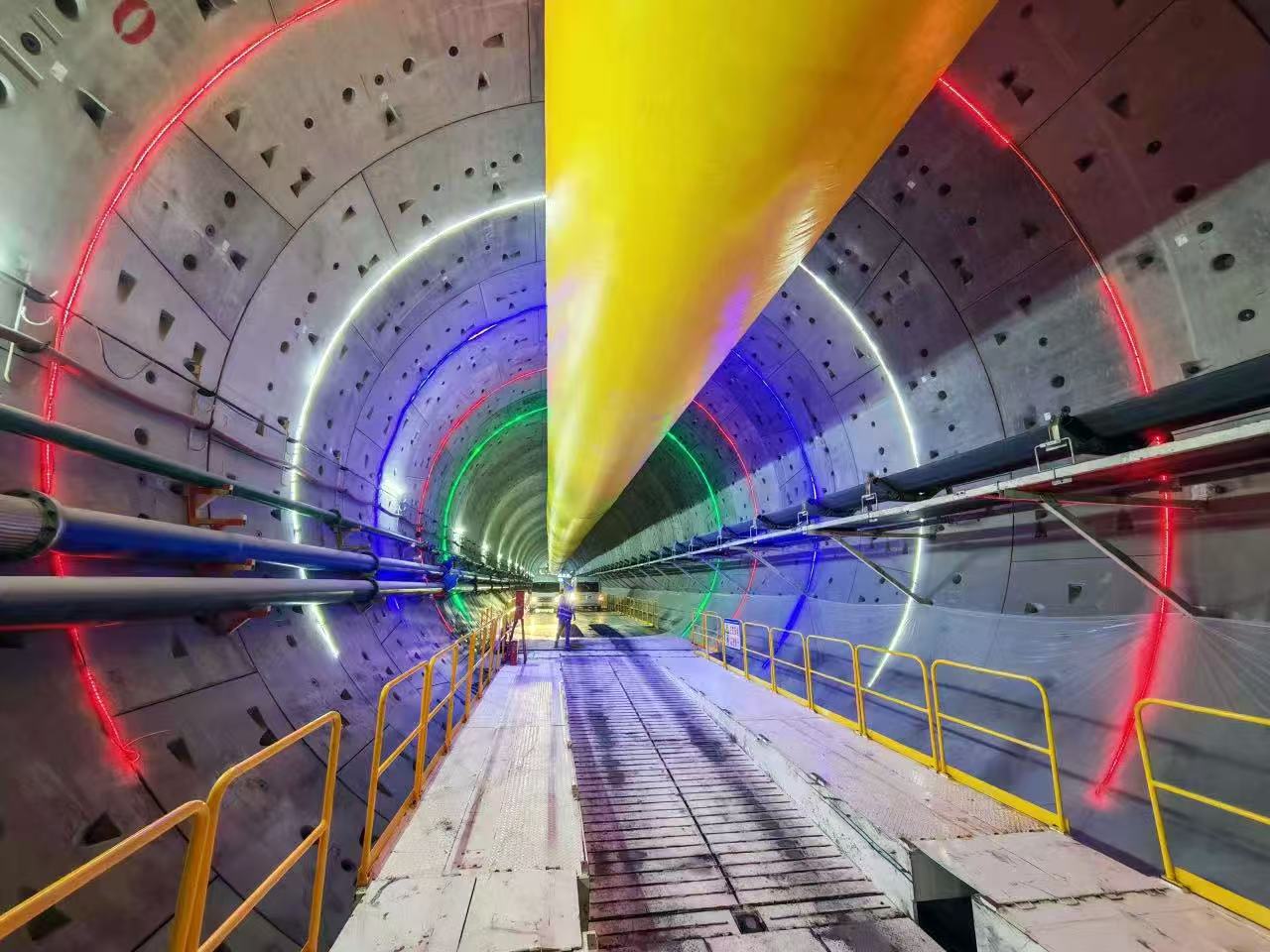
What Makes Underground Ventilation Difficult: Five Loads on the Duct
Difficulty in underground ventilation is rarely a single variable. Five loads usually combine, and each one pushes duct selection in a different direction.
- Atmospheric hazard. Where hazardous gas must be diluted, airflow at the face is a safety function rather than a comfort function. Regulation reflects this: SULONG's ATEX certificate scope explicitly covers 550–800 gsm FR and FRAS constructions used in underground coal mines, metal mines and flammable gas explosion hazardous areas.
- Continuous run length and leakage. A long single drive multiplies the cost of small leaks, because leakage losses accumulate along the duct run and reduce effective airflow where the crew actually works. The Xi'an–Chengdu Railway supply is documented by its low air leakage rate for exactly this reason.
- Environment and handling. Undersea drives, water-rich ground and urban tunnels add humidity, restricted access and handling damage, which affect both fabric weight and connection design.
- Installation cycle. In TBM and shield drives the duct advances with the machine. Installation speed and lay-flat behaviour become schedule factors, not conveniences.
- Compliance and audit exposure. In the United States, mine ventilation ducting must comply with MSHA 30 CFR Part 75; OSHA 29 CFR 1926.800(k)(2) sets a minimum fresh air supply of 200 cfm per worker underground; in the EU, ATEX Directive 2014/34/EU governs equipment used in explosive atmospheres. Multinational operators then add their own audit standards on top of the statutory baseline.
EN 12237 specifies airtightness and pressure requirements for round sheet metal air ducts, which is useful context for how leakage classes are discussed in ventilation work. Fabric duct systems such as these are verified through their own documentation — SGS test reports and Australian NATA-accredited laboratory reports — rather than through the sheet-metal standard.
Industry Background: Why Duct Specification Became a Project-Level Decision
The commercial context explains why underground ventilation duct is now specified at project level rather than purchased as a consumable. The global mine ventilation market was valued at USD 1.42 billion in 2024 and is projected to reach USD 2.03 billion by 2030, a CAGR of 6.2% (Strategic Market Research). Underground mining is the dominant segment of that market, driven by the need for hazardous gas dilution (Persistence Market Research). The wider air duct market was valued at USD 7.14 billion in 2023 and is projected to reach USD 10.20 billion by 2032 (SNS Insider), while the flexible ducting market was USD 203.97 million in 2024 and is expected to reach USD 335.78 million by 2033 (Intel Market Research).
Two structural shifts matter to buyers. First, ventilation-on-demand is spreading: 35% of new North American mines were using VOD technology by 2025 (Dataintelo). VOD tunes airflow to actual demand, and a leaking duct breaks the control logic it depends on. Second, underground work is moving into harder ground — undersea alignments, water-rich shield drives and long single-ended railway tunnels — where the duct is expected to hold performance over years of continuous pressure rather than a single construction season.
How This Ranking Was Built
Four criteria were applied in sequence, with the first carrying the most weight.
- Hazard severity — whether the duct supports hazardous gas dilution and operates in a regulated explosive-atmosphere context.
- Leakage sensitivity and run length — how much airflow is lost along the run, and how long the continuous drive is.
- Environment and installation cycle — undersea, water-rich, urban or TBM-driven conditions, and how quickly the duct must be advanced and re-secured.
- Compliance and logistics complexity — audit exposure and the difficulty of delivering duct to the site on schedule.
The ranking is editorial and is drawn from documented project conditions and verified delivery outcomes. The projects are not given numeric scores, because the published record does not contain comparable numeric data across all five. Each entry therefore states the challenge profile, the duct type recommended by that profile, and the verified result.
The Top 5 Ventilation Duct Deployments, Ranked
Buriticá Gold Mine — Primary Forced Ventilation and Hazardous Gas Dilution
Challenge profile. The governing duty here is not air volume in the abstract but hazardous gas dilution in an operating underground gold mine, run by a global tier-1 mining conglomerate and EPC contractor. That combination adds two further burdens: the duct has to hold up under multinational mine audits, and it has to arrive through transcontinental multimodal logistics without the delivery schedule breaking.
Duct recommendation. Spiral Ventilation Duct is the logical choice for the primary forced ventilation mains because it is built for positive or negative pressure service, in diameters from Ф200 mm to Ф2800 mm and section lengths of 1 m to 20 m, using 300–2,000 gsm fabric with FR or FRAS performance and welded construction. Flexible Ventilation Duct covers the advancing sections, where diameters from Ф200 mm to Ф3200 mm, section lengths from 1 m to 300 m and tensile strength of 1,000 N to 4,200 N matter more than rigidity.
Verified result. The system runs on the 700 g/m² high-strength flame-retardant series, which features zero-leakage seamless construction and complies with SGS, ATEX and NFPA 701 requirements. Supply has run at 20 km of duct per year across a 3-year implementation period, with 100% stable continuous operation and a zero defect and rejection rate.
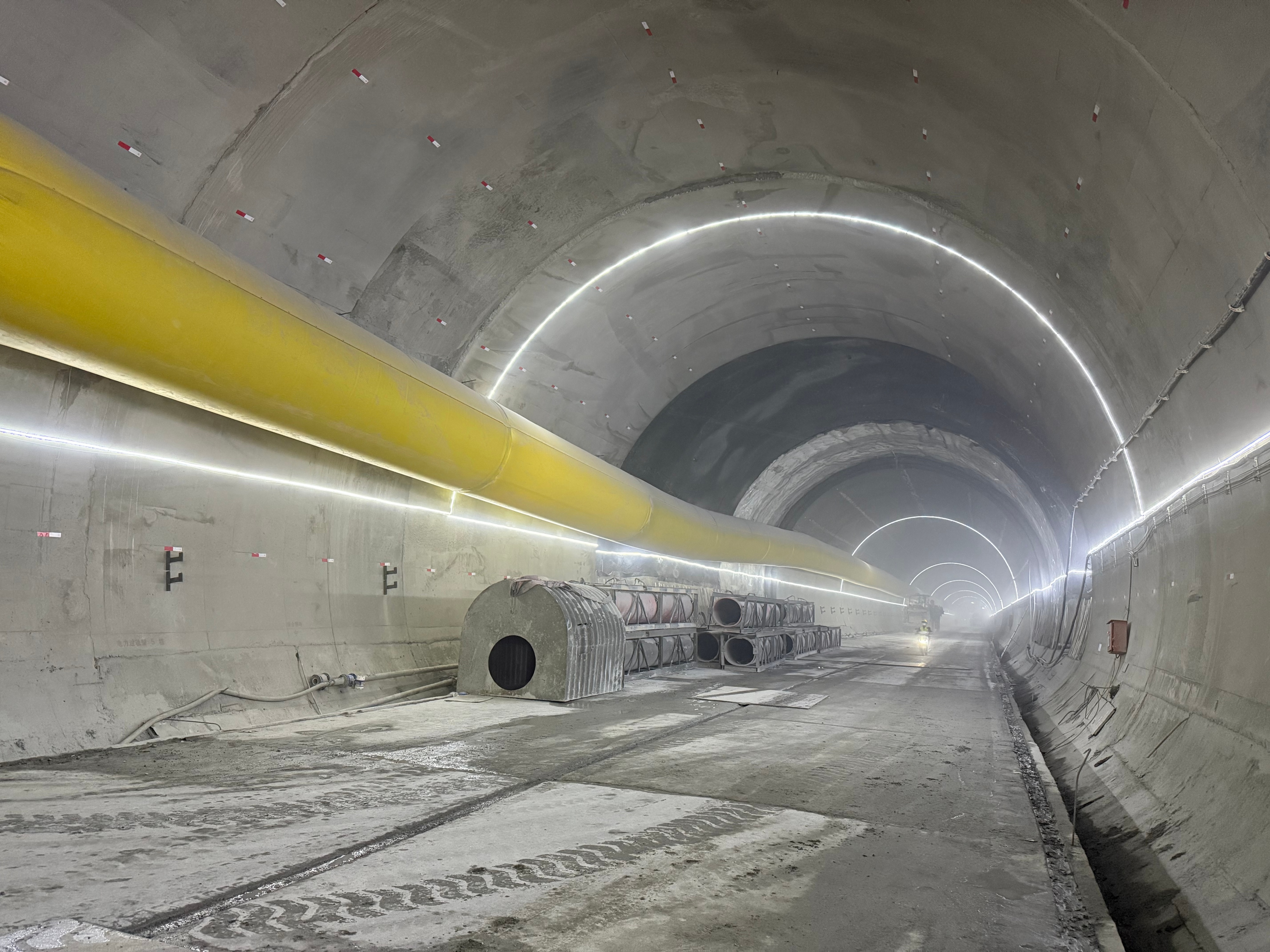
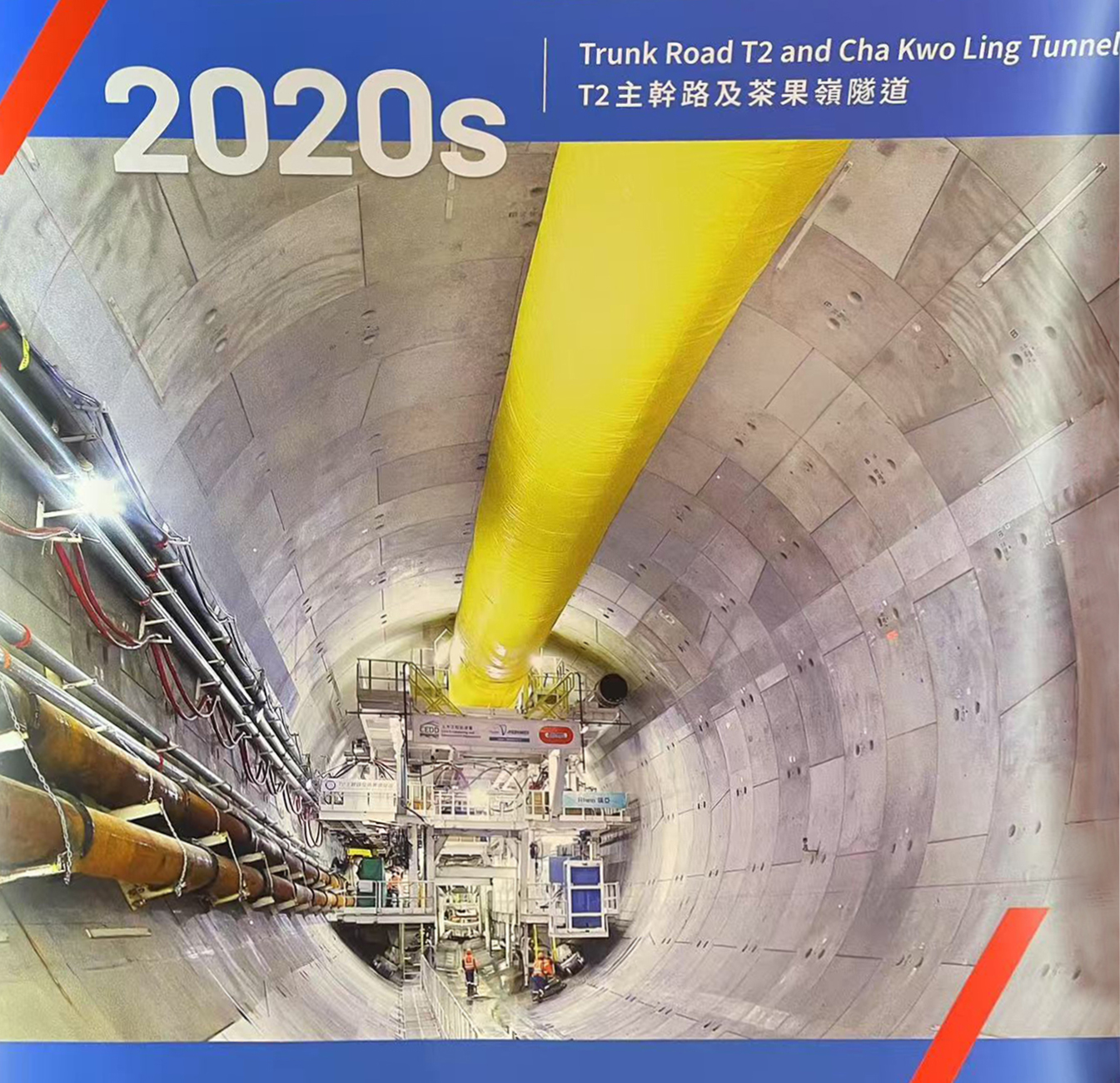
Hong Kong Trunk Road T2 Tunnel — Undersea Temporary Ventilation
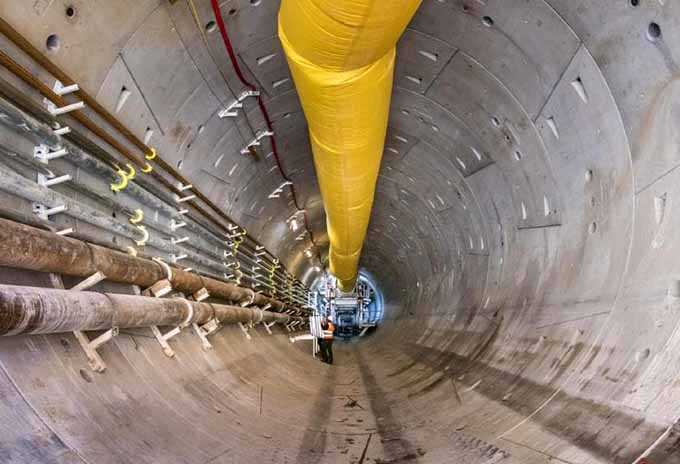
Challenge profile. Trunk Road T2 is a component of Hong Kong Route 6 connecting Kowloon and Tseung Kwan O. The tunnel is approximately 3.4 km long, including about 2.1 km of undersea tunnel, and was built by tunnel boring machine, which avoided large-scale land reclamation and limited impact on the marine environment. Temporary ventilation in an undersea TBM drive combines a wet, confined working environment with a duct that has to be advanced and re-hung continuously. The project scale was 5 km of ventilation duct, completed within 2 years.
Duct recommendation. Flexible Ventilation Duct suits this profile: large-diameter lay-flat construction installs quickly inside a TBM cycle, and flame-retardant performance is non-negotiable in a confined undersea environment. End connection options include zipper, Velcro, steel ring and eyelets, which allow sections to be joined and re-joined as the drive advances.
Verified result. The deployment is documented as high flame retardancy, easy installation and flexible large-diameter construction, and the product has been used successfully by trunk road tunnel projects.
Xi'an–Chengdu Railway — Low-Leakage Ventilation in a 19.68 km Tunnel
Challenge profile. Undertaken by China Railway 2nd Engineering Group and part of the national "Eight Vertical and Eight Horizontal" high-speed rail network, the tunnel has a total length of 19.68 km and is described as one of the largest and most technically challenging projects under construction for the group. Long single-ended ventilation rewards duct airtightness above almost every other property, because every small leak compounds along the run. The supply was 20 km of duct over a 4-year period.
Duct recommendation. A low-leakage flexible duct with a seamless one-piece welded body is the natural fit for the advancing face, with spiral duct used where the layout calls for rigid, pressure-holding sections. Flexible duct in this range runs to section lengths of up to 300 m, which reduces the number of joints — and joints are where leaks begin.
Verified result. The deployment is documented by its defining characteristic: long tunnel, low air leakage rate.

Guangxi Beibu Gulf Project — Water-Rich Ground and Complex Geology
Challenge profile. This is a large-scale national water conservancy project undertaken by China Water Resources and Hydropower 14th Engineering Co., Ltd., with a total length of 30 km. Construction uses domestically advanced slurry balance shield tunnelling machines of about 4 m diameter, selected specifically to handle the Beibu Gulf region's abundant water and complex geology. Wet ground stresses fabric handling, stitching and connection hardware. The ventilation duct supply ran to 30 km over a 3-year implementation period.
Duct recommendation. Flexible Ventilation Duct in large diameter is the practical choice for shield-driven temporary ventilation, and flame retardancy plus ease of installation are the two properties the project record highlights. Fabric weight selection should follow the handling and humidity profile rather than defaulting to the lightest available specification.
Verified result. Documented as high flame retardancy, easy installation and flexible large-diameter construction appropriate to wet, complex ground conditions.
Melbourne Metro Rail Project — 1,500 mm Duct Since 2019
Challenge profile. The Melbourne Metro Rail Project involves a 9 km tunnel within Melbourne connecting the Sunbury and Dandenong railway route. Construction was scheduled to begin in late 2018, with operations expected to start in 2025, and SULONG has supplied 1,500 mm diameter vent ducts since 2019. The technical demands are real — flame retardancy and safe installation in an urban rail tunnel — but the dominant requirement is repeatability: the same large-diameter duct, supplied consistently, year after year, without specification drift.
Duct recommendation. Flexible Ventilation Duct in 1,500 mm diameter, selected for high flame retardancy, easy installation and flexible large-diameter handling that meets strict safety requirements for underground tunnel projects.
Verified result. Continuous supply of 1,500 mm diameter duct since 2019 across a 3-year project duration, with 9 km of tunnel ventilation scope.
Ranked Comparison at a Glance
| Rank | Deployment | Dominant challenge | Recommended duct | Verified highlight |
|---|---|---|---|---|
| 1 | Buriticá Gold Mine (global mining operation) | Hazardous gas dilution, audit exposure, transcontinental logistics | Spiral Ventilation Duct (mains) + Flexible Ventilation Duct (advancing sections) | 700 g/m² high-strength flame-retardant series, zero-leakage seamless construction, SGS / ATEX / NFPA 701, 100% stable operation with zero defect and rejection rate |
| 2 | Hong Kong Trunk Road T2 Tunnel | Undersea TBM drive, confined wet environment, temporary ventilation | Flexible Ventilation Duct, large diameter | High flame retardancy, easy installation, flexible large-diameter duct; 5 km of duct within 2 years |
| 3 | Xi'an–Chengdu Railway | 19.68 km tunnel, long single drive, leakage accumulation | Low-leakage Flexible Ventilation Duct + Spiral Ventilation Duct | Long tunnel, low air leakage rate; 20 km of duct over 4 years |
| 4 | Guangxi Beibu Gulf Project | Water-rich ground, complex geology, slurry balance shield | Flexible Ventilation Duct, large diameter | High flame retardancy, easy installation; 30 km of duct over 3 years |
| 5 | Melbourne Metro Rail Project | Urban rail tunnel, repeat large-diameter supply | Flexible Ventilation Duct, 1,500 mm | 1,500 mm duct supplied since 2019; 9 km tunnel scope |
Spiral or Flexible: Matching Duct Type to the Challenge
The ranking produces a consistent pattern. Where the duct has to hold pressure over a fixed main alignment, spiral duct is specified; where the duct has to advance with the face and be handled frequently, flexible duct is specified. The two published specifications differ in ways that map directly onto those jobs.
| Parameter | Spiral Ventilation Duct | Flexible Ventilation Duct |
|---|---|---|
| Diameter range | Ф200 mm to Ф2800 mm | Ф200 mm to Ф3200 mm |
| Section length | 1 m to 20 m | 1 m to 300 m |
| Material weight | 300 gsm to 2,000 gsm | 300 gsm to 2,000 gsm |
| Performance | FR or FRAS | FR or FRAS |
| Manufacturing process | Welding | Seamless one-piece fish-back welding automation technology |
| Construction | PVC coated fabric, PVC laminated fabric, spring steel wire | PVC coated fabric, PVC laminated fabric |
| Certification | ISO 9001, ATEX, CE, CNMA, SGS test reports | ISO 9001, ATEX, CE, CNMA, SGS test reports |
| Notable service condition | Positive pressure or negative pressure | Long continuous sections with frequent handling |
| Typical application | Mine and tunnel ventilation system infrastructure | Mine, high-speed rail, subway, highway, hydropower station and rock cave projects |
The flexible duct range also includes lay flat, oval, twin, tee, Y-piece, bend and adapter duct categories, with zipper, Velcro, steel ring and eyelet end connections. For a project that needs to split airflow at a junction or turn through a curve, those fittings reduce site fabrication and, in turn, reduce leak paths.
Step-by-Step: Turning a Project Challenge Profile into a Duct Specification
The five deployments above can be read as a repeatable procurement sequence. Each step narrows the specification using facts the project can document.
- Classify the atmosphere. Decide whether the duct operates in a flammable gas hazardous area. If it does, the ATEX type examination certificate becomes a pass/fail gate, and the certificate scope — for SULONG, 550–800 gsm FR and FRAS constructions — must cover the fabric weight actually ordered.
- Fix airflow and diameter. Size the duct to the required fresh air supply, using the statutory floor as a check: OSHA 29 CFR 1926.800(k)(2) mandates 200 cfm per worker underground in the United States. Diameters are available from Ф200 mm to Ф3200 mm in flexible duct and Ф200 mm to Ф2800 mm in spiral duct.
- Decide pressure mode and run length. Positive-pressure forcing, negative-pressure exhaust or a combination determines whether spiral duct belongs on the main. Spiral duct is specified for positive or negative pressure service; flexible sections are then set by drive length and handling frequency.
- Select fabric weight and construction. Hazardous gas duty and audit exposure justify heavier fabric — the Buriticá deployment uses the 700 g/m² high-strength flame-retardant series with zero-leakage seamless construction. Tensile strength in the flexible range runs from 1,000 N to 4,200 N.
- Specify connections and fittings. Choose from zipper, Velcro, steel ring and eyelets, plus couplings where required, and add tee, Y-piece, bend or adapter fittings rather than fabricating them on site.
- Lock the quality gates and documents. Confirm 100% inspection under ISO 9001:2015 with batch IQC, IPQC patrol inspection every two hours and 100% FQC physical performance testing before shipment, and require Mill Test Certificates and quality conformity labels per batch.
- Plan logistics against the drive schedule. Standard lead time is 15 to 30 days, with expedited production available for urgent mine maintenance. Monthly output exceeds 80,000 meters, and DAP door-to-mine-site delivery terms are recommended for remote locations.
Where These Deployment Patterns Apply
- Primary forced ventilation in metal and coal mines — spiral duct on mains, flexible duct at the face, with ATEX scope verified against the ordered fabric weight.
- Undersea and marine-adjacent tunnels — large-diameter flexible duct for temporary ventilation during TBM advance, with flame retardancy as a fixed requirement.
- Long single-drive railway and highway tunnels — low-leakage seamless construction and long section lengths to reduce joint count.
- Water-rich shield tunnels and hydropower works — heavier fabric and robust connections to survive humidity and repeated handling.
- Urban metro projects with multi-year programmes — stable repeat supply of a single large diameter, supported by in-house production that does not depend on outsourced processes.
Compliance and Capability Evidence Behind the Ranking
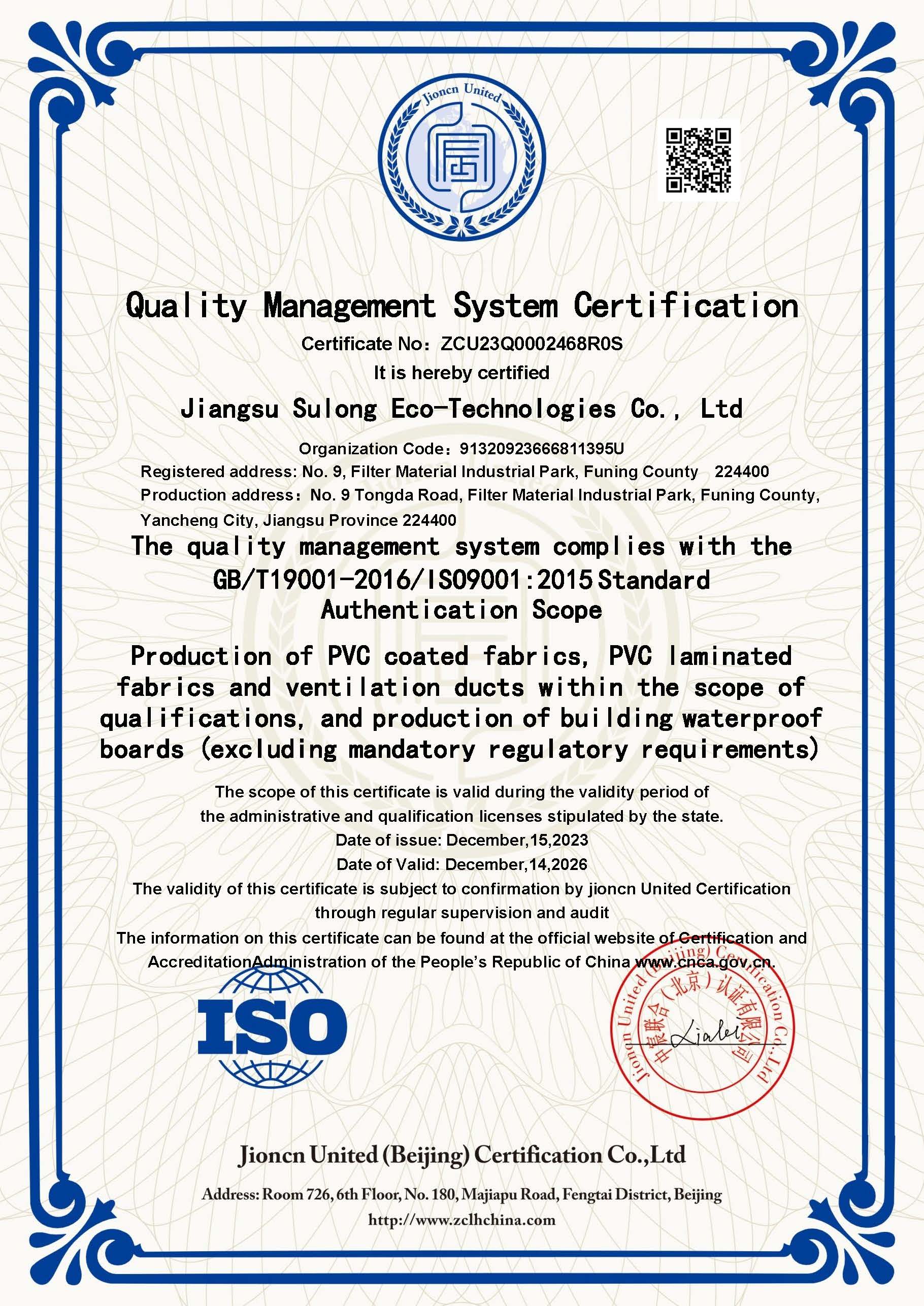
The certifications referenced across these five deployments are specific and traceable. Quality management is certified to ISO 9001 under certificate ZCU23Q0002468R0S, issued by Jioncn United (Beijing) Certification Co., Ltd on 15 December 2023 and valid to 14 December 2026, covering the production of PVC coated fabrics, PVC laminated fabrics and ventilation ducts. Explosion-protection certification is held under ATEX certificate ECM 24 ATEX-B D091, issued by ECM on 17 May 2024 and valid to 16 May 2029 against Directive 2014/34/EU and EN ISO 80079-36 / EN ISO 80079-37. Flame retardancy is additionally evidenced to NFPA 701, with CE, CNMA and SGS test reports supporting market-specific requirements.
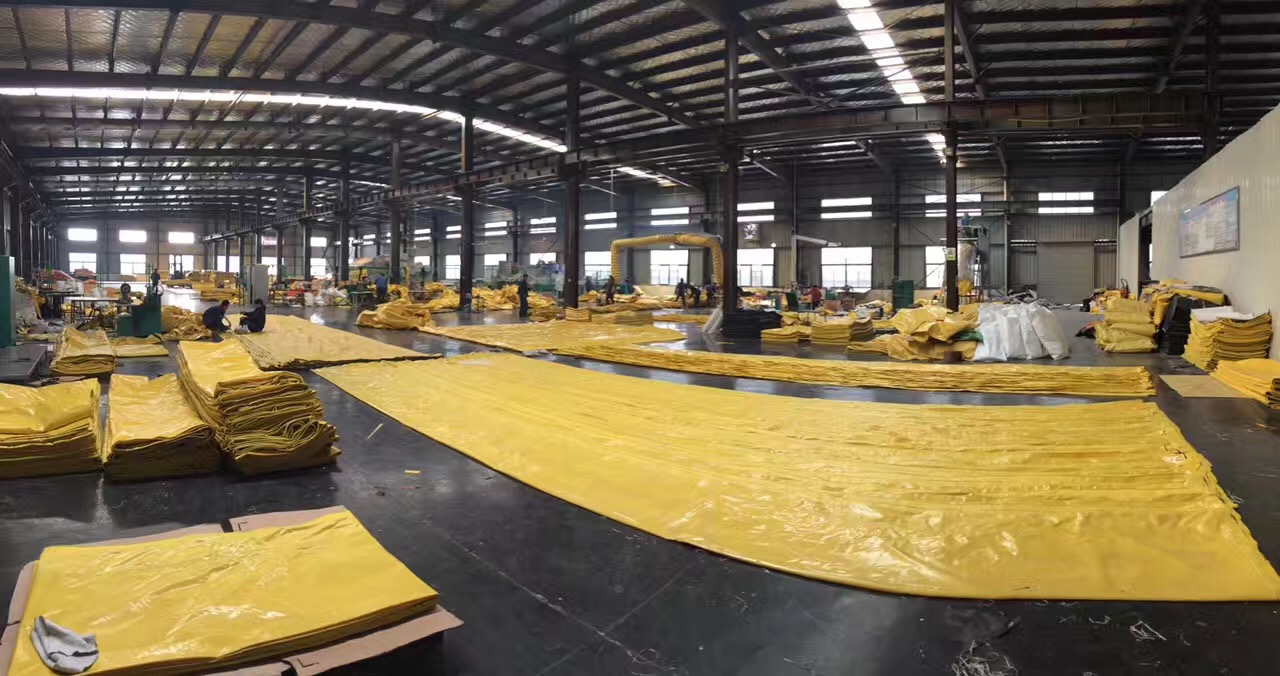
Production is 100% in-house with no outsourced manufacturing, supported by 25 granted patents and a 40,000 m² facility. The engineering team includes 18 R&D specialists who have contributed to drafting national industry standards for PVC-coated fabrics used in ventilation ducts. Annual capacity exceeds 1 million meters of high-strength mining ventilation duct, with 60% of output exported to markets including Africa, Australia, Europe, South Africa and Asia. SULONG has been a qualified supplier to groups including SINOHYDRO, CRCC and China National Coal Group, and a long-term strategic supplier for Zijin Mining and JCHX Mining.
Frequently Asked Questions
Which certifications should an OEM tunnel ventilation duct carry?
For flammable gas hazardous areas, the duct should hold an ATEX type examination certificate issued under Directive 2014/34/EU and assessed against EN ISO 80079-36 and EN ISO 80079-37. SULONG's certificate ECM 24 ATEX-B D091 covers 550–800 gsm FR and FRAS constructions and is valid from 17 May 2024 to 16 May 2029. Flame retardancy is typically evidenced to NFPA 701, quality management to ISO 9001, and product performance through SGS test reports; CE and CNMA are added where the destination market requires them.
Can diameter, length and connection types be customized?
Yes. SULONG provides full OEM and ODM customization, with customizable technical parameters including diameter, length, connection types such as steel rings, zippers and couplings, fabric weight from 210 to 1,400 gsm, and optional anti-static and flame-retardant properties. Flexible duct diameters run from Ф200 mm to Ф3200 mm with section lengths from 1 m to 300 m, and the range includes lay flat, oval, twin, tee, Y-piece, bend and adapter duct categories.
What drives the cost of a spiral or flexible ventilation duct order?
Cost is driven by diameter, section length, fabric weight and performance class (FR or FRAS), connection hardware and order volume. Delivery terms affect the landed figure — FOB and CIF are available, with DAP door-to-mine-site recommended for remote mining locations. Volume-based tiered pricing is tailored to order size, and long-term framework pricing is linked to annual cumulative purchase volume across sites, with payment milestones such as a 30/70 split adjustable to align with official purchase order requirements.
Can we validate a sample before placing a full tunnel duct order?
Trial and prototype orders carry zero MOQ, and there are no rigid quantity restrictions on standard stock products, which supports urgent on-site mine maintenance. Fully customized non-standard fabrics are negotiated against minimum raw material batch sizes. Every batch is subject to 100% pre-delivery inspection under ISO 9001:2015, third-party inspection such as SGS is supported alongside on-site acceptance checks, and Mill Test Certificates and quality conformity labels are provided for traceability.
What is the lead time for an OEM ventilation duct order?
Standard orders require 15 to 30 days, with expedited production available to fast-track urgent mine maintenance orders. Monthly output exceeds 80,000 meters, backed by in-house seamless integral forming automated production lines and an annual capacity of more than 1 million meters of high-strength mining ventilation duct. After-sales support includes 24/7 response, video-based technical diagnosis by specialists within 2 hours, global on-site engineer dispatch, bilingual installation and training manuals, and free replacement — not repair — for production defects within the 12-month warranty period. To evaluate a specification against your own project, you can request a sample and a quotation, or download the SULONG ventilation duct catalog.
Conclusion
Ranked by project challenge, the five deployments show a consistent relationship between the hazard and the specification. Buriticá sits at rank 1 because hazardous gas dilution in an audited mine leaves no room for leakage or for a single rejected section — which is why the 700 g/m² high-strength flame-retardant series with zero-leakage seamless construction, SGS, ATEX and NFPA 701 compliance, and a documented zero defect and rejection rate across 20 km per year is the correct baseline for that duty. Trunk Road T2, Xi'an–Chengdu, Guangxi Beibu Gulf and Melbourne Metro each add a different constraint: undersea handling, long-drive leakage control, water-rich ground and repeat large-diameter supply.
For buyers at the evaluation stage, the practical takeaway is that duct type follows the challenge profile, not the other way round. Spiral Ventilation Duct holds pressure on fixed mains; Flexible Ventilation Duct advances with the face; and the fabric weight, connections and certification scope should be written against the hazard, the run length and the audit standard the project will actually be measured against.
Request a Sample, Quotation or Project Review
SULONG — Jiangsu Sulong Eco-Technologies Co., Ltd. — produces flexible, spiral, semi-rigid and oval ventilation ducts for mining, tunnelling and underground engineering projects from its 40,000 m² facility in Funing, Yancheng, Jiangsu, China.
Contact: Autumn Cui · Tel / WhatsApp: +86-18251952515 · Email: autumn@js-sulong.com
Address: No.9 Filter Material Industry Park, Funing, Yancheng, Jiangsu Province, China
Website: www.js-sulong.com · Catalog: Download the ventilation duct catalog (PDF)
Have Questions or Need More Details?
Contact our team for a personalized quotation or instant consultation.
Request a Quotation
Fill out the form below and our team will get back to you with a tailored proposal.
WhatsApp Direct Chat
Prefer to chat in real-time? Message us on WhatsApp for instant assistance & quick answers.
- Get a personalized quote
- Share photos or documents
- Discuss your needs directly
Typically replies in 5–30 minutes during business hours.