Spiral vs Flexible Ventilation Duct: What the Trunk Road T2 Undersea Tunnel Decision Turns On
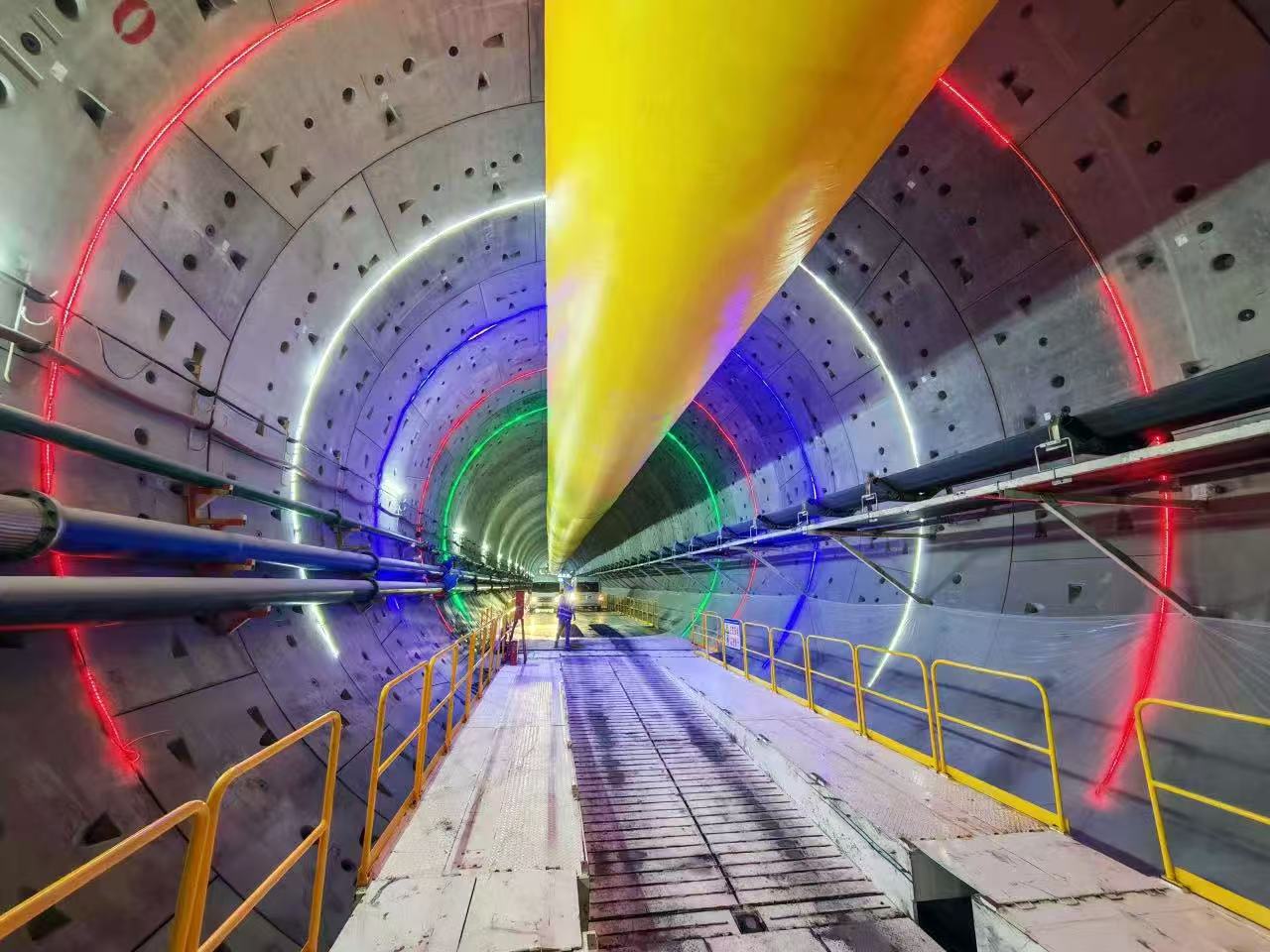
Short answer: in undersea road tunnel construction, spiral ventilation duct and flexible ventilation duct are not competing substitutes for one single duty. The Hong Kong Trunk Road T2 Tunnel — approximately 3.4 km long, about 2.1 km of it undersea, with a ventilation duct programme of roughly 5 km — used both. What consumes a contractor's time is not picking a winner from a catalogue, but deciding which duct geometry goes where along the drive, and whether one supplier can keep both duct types flowing to site against flame retardancy, installation, large-diameter and long-term supply requirements.
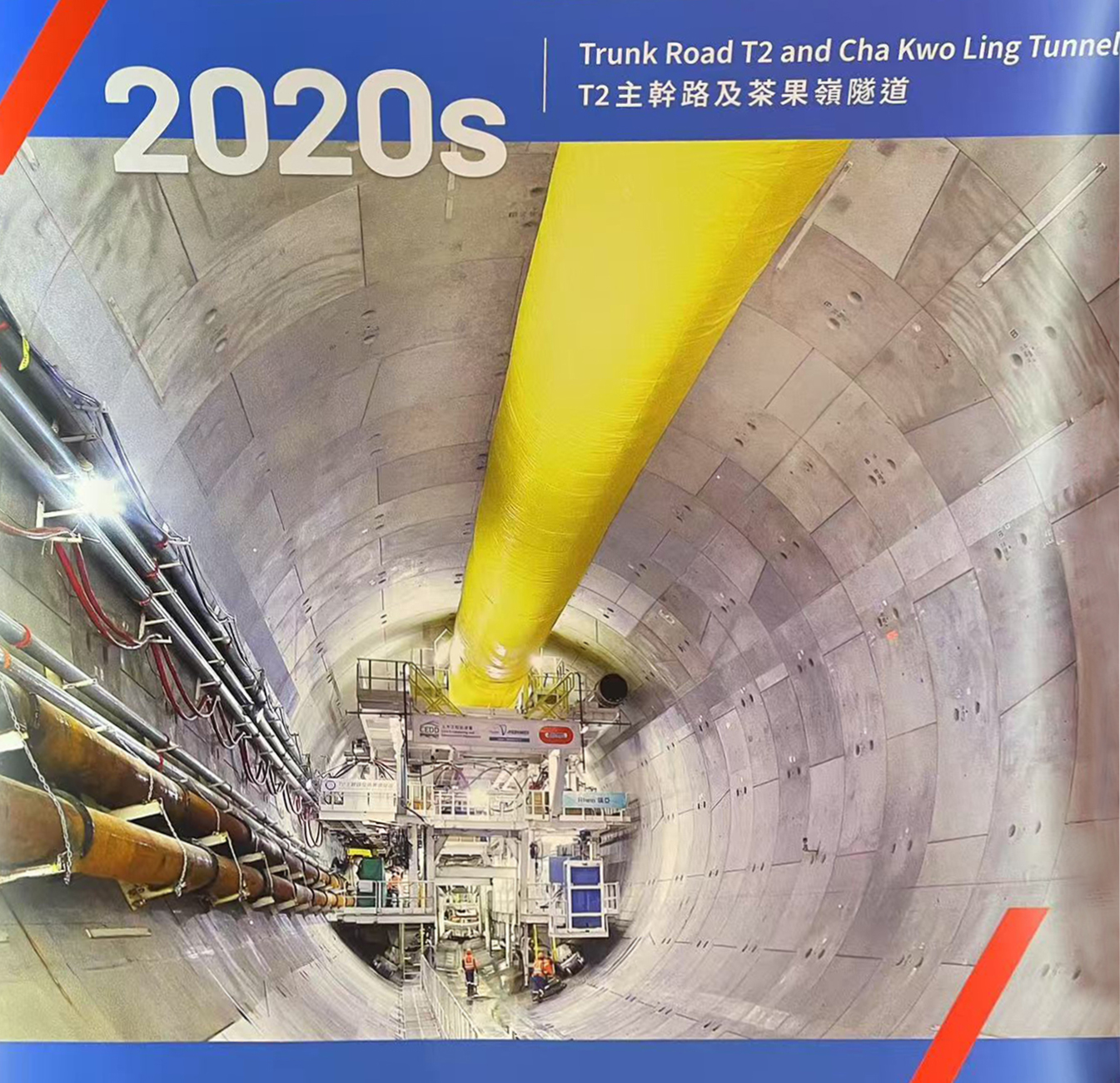
Undersea alignments remove most of the improvisation that tunnel engineers normally rely on. An intermediate access shaft above the alignment is typically not an option, so the duct string has to deliver fresh air to the face from the portal or from a shore-side shaft. Pressure loss and leakage accumulate across kilometres rather than hundreds of metres. Every extension, inspection and repair happens inside the tunnel, performed by a crew whose time is already committed to excavation and lining.
That is the environment in which the spiral-versus-flexible decision is really taken — on site, under programme pressure, with a compliance reviewer waiting for documentation.
The Undersea Tunnel Ventilation Decision, Defined
Temporary construction ventilation duct is the duct string that carries fresh air from the surface fan station to the working face while a tunnel is being excavated. It is a construction asset with a service life tied to the excavation programme, not the permanent ventilation system that the finished tunnel operates.
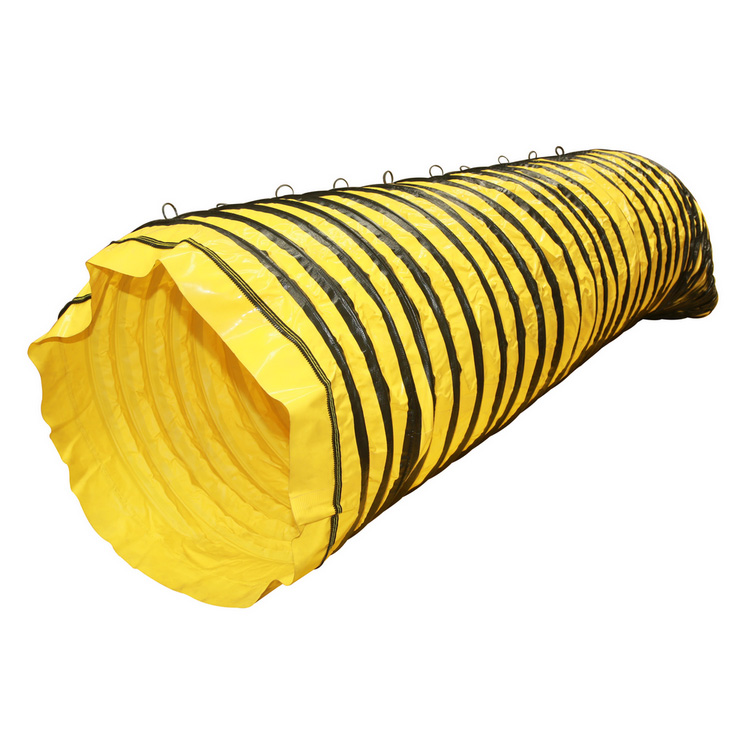
The two duct families differ in how they hold shape and how they are installed. Spiral ventilation duct is a shape-stable duct with a formed spiral structure, supplied with matched spiral duct fittings for connections, bends and transitions, and it keeps a fixed circular profile along the run. Flexible ventilation duct is a lay-flat duct supplied in long, continuous lengths. Jiangsu Sulong Eco-Technologies Co., Ltd (SULONG), a Jiangsu-based manufacturer of mining and industrial ventilation ducts, supplies lay-flat ventilation ducts in diameters from 200 mm to 3,200 mm.
Terminology shifts with region and sector. In mining, the same flexible product is often ordered as a ventilation bag or flexible ventilation bag; ventilation tube and flexible ventilation tube describe the same family. The selection logic does not change with the label.
Three problem conditions define the undersea case. First, the drive is continuous, so the duct must be extended in step with excavation instead of installed once. Second, the duct sits inside a fire-safety and ventilation submission, so flame retardancy and certification are entry conditions rather than differentiators. Third, a 5 km duct programme is a supply commitment measured in months, which makes delivery continuity a technical criterion, not a commercial footnote.
Industry Background: Duct Demand Under Rising Compliance Pressure
The duct decision now sits inside a market that is growing steadily and auditing harder. Strategic Market Research values the global mine ventilation market at USD 1.42 billion in 2024, projected to reach USD 2.03 billion by 2030 at a CAGR of 6.2%. Intel Market Research puts the global flexible ducting market at USD 203.97 million in 2024, rising to USD 335.78 million by 2033. Spherical Insights reports that over 2.1 billion metres of flexible ducting were manufactured globally in 2023, with 30% dedicated to industrial ventilation. SNS Insider values the broader global air duct market at USD 7.14 billion in 2023, projected to reach USD 10.20 billion by 2032.
Regional supply matters as much as global demand. Dataintelo reports that Asia Pacific dominated the spiral duct fittings market in 2025 with a 38.2% revenue share, driven by urbanization and industrial expansion — a relevant signal for projects that intend to source spiral and flexible duct from one manufacturing base. At the supplier level, Fortune Business Insights lists Lindab Group and Systemair among the top competitors in the global industrial ventilation duct market as of 2024, a useful benchmark when a contractor is shortlisting flexible duct suppliers or spiral duct suppliers rather than duct types.
Regulation sets the floor for both duct families. In the United States, underground ventilation ducting must comply with MSHA 30 CFR Part 75 for underground safety, and OSHA 29 CFR 1926.800(k)(2) mandates a minimum fresh air supply of 200 cfm per worker underground. In Europe, EN 12237 specifies airtightness and pressure requirements for round sheet metal air ducts, the standard that governs rigid circular duct performance in European submissions. On flame retardancy specifically, SULONG ventilation ducts are certified to NFPA 701:2015 and DIN 4102 B2, with a performance classification of FR or FRAS.
Where Each Duct Type Earns Its Place on an Undersea Drive
Spiral ventilation duct: fixed profile, high tensile demand
Spiral duct is specified where the duct string must hold a stable profile and where fan pressure loads the duct wall. In SULONG's specification set, spiral ventilation duct applications require high tensile strength of up to 4,200 N, flame retardancy (FR) and surface anti-static resistance, and the spiral ventilation duct complies with ISO 9001, ATEX, CE, CNMA standards and SGS Test Report requirements. In execution terms, that combination suits drive sections where the duct layout is fixed and where bends, transitions and connections must be engineered rather than improvised.
Flexible ventilation duct: continuous coverage and fast advancement
Flexible duct is specified where the duct has to be extended continuously and where large diameters must be delivered as one lay-flat string. SULONG flexible ventilation ducts carry a flame-retardant protection level compliant with NFPA 701:2015 and DIN 4102 B2, with an FR or FRAS performance classification, and flexible ventilation duct applications require high tensile strength together with flame retardancy. The 200 mm to 3,200 mm lay-flat diameter range is what makes a single-string ventilation scheme practical on a long undersea drive.
Semi-rigid, oval and twin duct options
Between the two poles sit semi-rigid duct, which retains part of its shape while still being supplied in flexible lengths, and oval duct, which adapts a round duct profile to restricted space. Twin duct configurations serve applications where two air paths run in parallel. None of these replace the spiral-versus-flexible decision; they extend the routing options once the primary decision has been made.
The Four Criteria That Decide the Head-to-Head
On the Trunk Road T2 Tunnel, the duct programme was not resolved by a single parameter. Four criteria carry the decision, and each one has to be answered with documentation rather than preference.
- Flame retardancy and the compliance floor. Both duct types must satisfy the project fire-safety requirement before any technical comparison begins. SULONG flexible ventilation ducts comply with NFPA 701:2015 and DIN 4102 B2 flame-retardant protection levels with an FR or FRAS classification, and SULONG products meet ISO 9001, ATEX, CE, CNMA and SGS Test Report requirements. In a high-gas environment, an ATEX ventilation duct specification adds surface anti-static resistance to the requirement set.
- Installation and handling time inside the tunnel. Flexible lay-flat duct arrives in long continuous lengths and is typically extended as the face advances; spiral duct arrives as shape-stable sections that are jointed in place with matched fittings. Both are legitimate on a long drive, but they consume different amounts of crew time per metre advanced, which is why the routing decision is ultimately a scheduling decision.
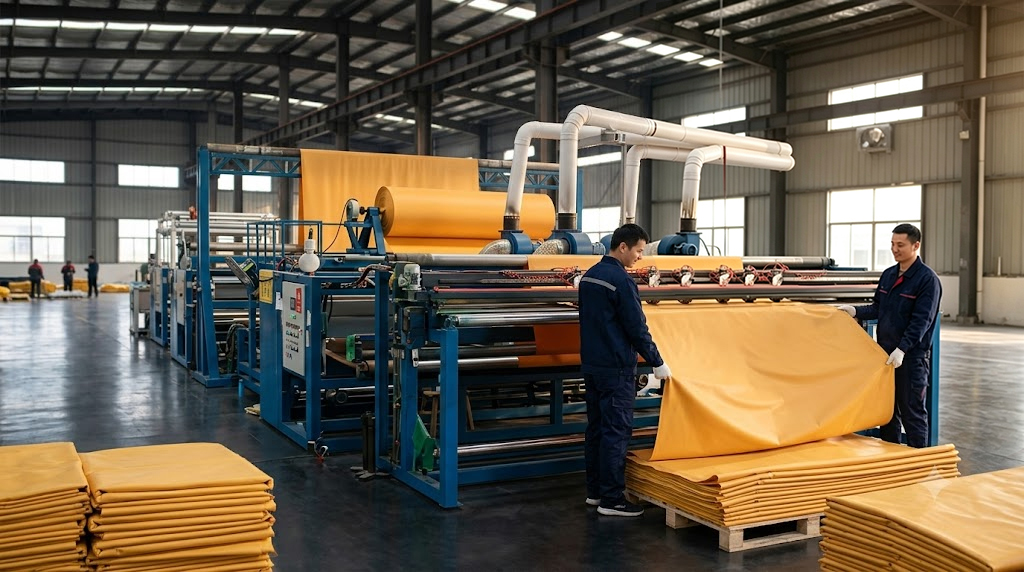
- Large-diameter capability and airflow performance. A multi-kilometre drive only works if the duct string delivers the required air volume at acceptable pressure loss. SULONG's lay-flat duct range covers 200 mm to 3,200 mm diameter; the seamless integral forming process used in SULONG production reduces leakage to nearly 0% under high air pressure and lowers wind drag through continuously smooth internal walls. Duct fabric tensile strength across the SULONG range runs from 1,300 N to 4,300 N.
- Long-term supply continuity. A 5 km duct programme is not one purchase order. It is a sequence of deliveries that must track excavation progress, clear transport and customs, and include fittings, spares and repair stock. This is where a supplier's production and logistics structure decides whether the duct type selected on paper survives contact with the programme.
Step-by-Step: Running the Head-to-Head Decision During Execution
- Fix the compliance floor first. Confirm the flame-retardant classification required (FR or FRAS), the anti-static requirement, and the certification framework the project will audit against — ISO 9001, ATEX, CE, CNMA and SGS Test Report — alongside any national framework that applies, such as MSHA 30 CFR Part 75 in the United States or EN 12237 for rigid circular duct in Europe.
- Map the ventilation duty along the drive. Break the drive into sections by distance from the fan station and required air volume, then decide which sections can be ventilated with a large-diameter flexible string and which need a shape-stable spiral run.
- Plan the transitions. Every change between spiral and flexible duct is a fitting point. Spiral duct fittings, connectors and repair provisions should appear in the same submittal as the duct itself, so transitions never become a site improvisation.
- Verify performance data before mobilisation. Request tensile strength figures, leakage performance under high air pressure, anti-static data and airflow behaviour for the exact diameters proposed for the drive.
- Validate handling with the tunnel crew. Trial and prototype orders carry zero MOQ at SULONG, which lets a crew install a sample length under real tunnel conditions before the full order is released. Standard stock products carry no rigid quantity restrictions, supporting urgent on-site maintenance.
- Agree acceptance criteria and documentation. SULONG conducts 100% pre-delivery inspection, supports third-party inspection such as SGS and on-site acceptance checks, and provides Mill Test Certificates and quality conformity labels for every batch.
- Lock the supply continuity plan. Confirm monthly capacity, order windows and delivery terms. The SULONG production facility has a monthly capacity exceeding 80,000 metres and an annual capacity of over 1 million metres of high-strength mining ventilation ducts. Exports are managed through Nanjing Sulun International Trading Co., Ltd, cooperating with mining-specific freight routes operated with Blue Water Shipping; delivery terms include FOB, CIF and DAP door-to-mine-site.
- Agree the commercial structure. Volume-based tiered pricing plans are tailored to order size, and long-term framework pricing can be linked to annual cumulative purchasing volumes. Payment milestones such as the standard 30/70 split can be adjusted to align with official Purchase Order requirements.
Use Cases Where the Same Decision Repeats
- Undersea road tunnels. The Trunk Road T2 Tunnel is the reference case: approximately 3.4 km of alignment, about 2.1 km undersea, and a ventilation duct programme of roughly 5 km in which both spiral and flexible duct were used. The lesson transfers directly to other subsea road and rail drives with a single long ventilation path.
- Long single-drive TBM and drill-and-blast headings. SULONG application data identifies large-volume, long-distance underground ventilation and ultra-long tunneling construction as the duties where low-leakage, low-drag duct performance matters most.
- High-gas metal mines. The same application set names high-gas metal mines and mining environments subject to strict international standard audits, where an ATEX-oriented specification and surface anti-static resistance sit alongside flame retardancy.
- Projects under multinational audit regimes. SULONG project delivery records describe 100% stable and continuous operation with a zero defect and rejection rate, ensuring fresh underground air supply and compliance with safety standards for multinational mine audits. The manufacturing base maintains a 0% customer rejection rate with zero safety and environmental regulatory penalties over the past three years, and a Lost Time Injury Frequency Rate (LTIFR) of 0 across 2023, 2024 and 2025.
Spiral vs Flexible Ventilation Duct: Head-to-Head Comparison
| Decision dimension | Spiral ventilation duct | Flexible ventilation duct | What it means during execution |
|---|---|---|---|
| Primary role on a long drive | Shape-stable profile, supplied with spiral duct fittings for bends and transitions | Lay-flat duct in continuous lengths; SULONG range from 200 mm to 3,200 mm diameter | Flexible strings are typically extended as the face advances; spiral runs are installed where the profile must stay fixed |
| Flame retardancy | Flame-retardant construction against the project requirement; FR classification | Protection level compliant with NFPA 701:2015 and DIN 4102 B2; FR or FRAS classification | Both duct types must clear the fire-safety and ventilation review before mobilisation |
| Tensile and anti-static requirements | Application requires high tensile strength up to 4,200 N plus surface anti-static resistance | Application requires high tensile strength and flame retardancy | Tensile and anti-static data belong in the same submittal as the duct layout |
| Certification framework | ISO 9001, ATEX, CE, CNMA and SGS Test Report | ISO 9001, ATEX, CE, CNMA and SGS Test Report | One compliance dossier can cover both duct types when both come from the same manufacturer |
| Airflow and leakage | Produced on in-house seamless integral forming automated lines | Leakage reduced to nearly 0% under high air pressure; ultra-low wind resistance and smooth internal walls | Lower leakage supports airflow delivery across a multi-kilometre undersea drive |
| Fittings and spares | Spiral duct fittings for connections, bends and transitions | Portable on-site repair kits for accidental damage | Fittings and repair stock must be ordered together with the duct, not after it |
| Quality documentation | Material Test Certificates with traceability to raw material batches | 100% pre-delivery physical performance testing with batch traceability | Acceptance at the tunnel gate can rely on documented evidence instead of re-testing |
| Supply continuity | Over 80,000 m monthly capacity from the same production base | Same production base; annual capacity over 1 million metres of high-strength ducts | A single supplier for both duct types removes split-shipment risk on a 5 km duct programme |
Reading the table: no row produces an automatic winner. Spiral duct answers fixed-profile and high-pressure sections; flexible duct answers continuous advancement and large-diameter coverage. The practical outcome is a routing plan that uses both, backed by one compliance dossier and one supply channel.
FAQ
What flame retardancy and certification requirements apply to ventilation ducts in an undersea tunnel?
Undersea tunnel ventilation ducts are normally specified against a flame-retardant protection level and a certification framework at the same time. SULONG flexible ventilation ducts carry a flame-retardant protection level compliant with NFPA 701:2015 and DIN 4102 B2, with a performance classification of FR or FRAS, and SULONG products meet ISO 9001, ATEX, CE, CNMA and SGS Test Report requirements. Applications in high-gas or heavily audited environments also require high tensile strength, flame retardancy and surface anti-static resistance, which is reported as part of the same technical submittal. National frameworks may add their own requirements, such as MSHA 30 CFR Part 75 for underground safety in the United States and EN 12237 for round sheet metal air duct airtightness and pressure performance in Europe.
Can one supplier provide both spiral and flexible ventilation ducts for the same tunnel project?
Yes, and on a long undersea drive that is usually the preferred structure. SULONG manufactures flexible ventilation duct, spiral duct, semi-rigid duct, oval ducts and twin duct inside one in-house production system, on automated lines for seamless integral forming. The facility has a monthly production capacity exceeding 80,000 metres and an annual capacity of over 1 million metres of high-strength mining ventilation ducts. SULONG was founded in 2007, operates a 40,000 m2 factory, employs 68 people, and its 18 R&D specialists have contributed to drafting national industry standards for PVC-coated fabrics used in ventilation ducts. Sourcing both duct types from one manufacturer also means one compliance dossier and one traceability chain.
How should duct cost and payment structure be organised across a multi-year tunnel contract?
Duct cost on a long drive is driven by three factors: delivered volume, the fan energy consumed by air leakage, and the labour cost of installing and maintaining the string. SULONG structures commercial terms around volume-based tiered pricing tailored to order size, with long-term framework pricing linked to annual cumulative purchasing volumes. Delivery can be arranged on FOB, CIF or DAP terms, and payment milestones such as the standard 30/70 split can be adjusted to match official Purchase Order requirements. Technically, leakage reduced to nearly 0% under high air pressure lowers daily energy cost, exceptional tear strength reduces routine maintenance frequency, and portable on-site repair kits cut downtime caused by accidental damage.
Can spiral and flexible ducts be trialled before a full order is placed?
Trial and prototype orders at SULONG carry zero MOQ, and there are no rigid quantity restrictions on standard stock products — a structure that supports sample validation as well as urgent on-site maintenance. Fully customized non-standard fabrics can be negotiated amicably, subject to minimum raw material batch sizes. Once an order is placed, acceptance is supported by 100% pre-delivery inspection, third-party inspection such as SGS and on-site acceptance checks, with Material Test Certificates and quality conformity labels provided for every batch and full traceability back to raw material batches.
How is delivery continuity maintained for a long-term tunnel ventilation duct supplier?
Continuity starts with production capacity and process control. SULONG produces 100% in-house in a 40,000 m2 facility, with monthly output exceeding 80,000 metres and annual capacity above 1 million metres, so spiral and flexible duct can be scheduled from the same base rather than split across subcontractors. A three-tier QC framework — IQC raw material batch quarantine, 2-hour IPQC patrol inspections and 100% pre-delivery FQC physical performance testing — keeps every finished duct traceable to its raw material batch. Export logistics run through Nanjing Sulun International Trading Co., Ltd, cooperating with Blue Water Shipping mining-specific freight routes and dual-window international logistics partnerships to reduce customs and transit exposure. To discuss a long-term supply arrangement, request a sample, or review the full duct range, contact the SULONG team directly or download the product catalogue from the link below.
Conclusion: The Decision Is a Routing Plan Plus a Supply Plan
The Trunk Road T2 Tunnel case settles the spiral-versus-flexible question in a way that a specification table cannot: on a 3.4 km undersea alignment with roughly 5 km of ventilation duct, both duct types were used. Spiral duct holds the sections where the profile must stay fixed and the wall must carry fan pressure; flexible duct covers the long, continuously advancing sections and the large diameters that a single-string scheme depends on.
For a contractor at the decision-to-execution stage, that converts into two deliverables. The first is a routing plan that assigns each duct type to a drive section and lists the fittings, transitions and spares required to connect them. The second is a supply plan that confirms flame-retardant classification, certification documentation, monthly production capacity, delivery terms and acceptance criteria before mobilisation begins — because a duct programme of several kilometres is only as reliable as the supplier's ability to keep delivering it.
Next step: SULONG supplies flexible ventilation duct, spiral duct, semi-rigid duct and oval duct for tunnel and mining ventilation programmes, with a monthly capacity exceeding 80,000 metres and a layered QC and traceability system behind every batch.
Request a sample or a technical quote, or download the full catalogue here: SULONG Ventilation Duct Catalogue (PDF).
Contact: Autumn Cui | Tel / WhatsApp: +86 182 5195 2515 | Email: autumn@js-sulong.com | Website: www.js-sulong.com
Have Questions or Need More Details?
Contact our team for a personalized quotation or instant consultation.
Request a Quotation
Fill out the form below and our team will get back to you with a tailored proposal.
WhatsApp Direct Chat
Prefer to chat in real-time? Message us on WhatsApp for instant assistance & quick answers.
- Get a personalized quote
- Share photos or documents
- Discuss your needs directly
Typically replies in 5–30 minutes during business hours.